
Safety model
Conservative defaults — plan before mutation, dry-run before deletion, ownership-aware cleanup, and no secrets in logs.
Infrastructure tooling earns trust by being predictable when things go wrong. Hostwright’s safety posture is deliberately conservative, and the defaults reflect that.
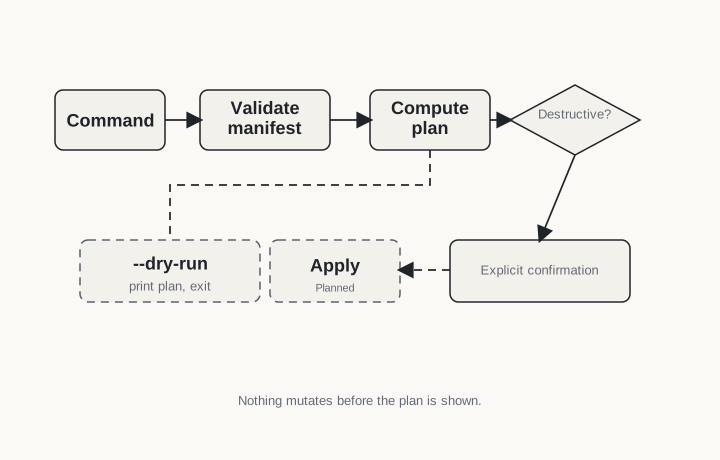
Principles
- Plan before mutation. Runtime changes are computed and reviewable before they run.
- Dry-run for cleanup. Destructive operations preview exactly what they would remove.
- Explicit destructive confirmation. Removing real resources is an intentional, confirmed action.
- Conservative validation. Unsafe or ambiguous manifests are refused, not guessed at.
- No hidden runtime mutation. Nothing changes the runtime outside the planned, recorded path.
- Ownership-tracked cleanup. No broad garbage collection — only resources Hostwright can prove it owns.
- No secret leakage in logs. Secrets and credentials are kept out of events and log output.
Ownership
Hostwright must distinguish resources it created from resources you created by hand. Every Hostwright-created resource carries project and service ownership metadata where the runtime supports it; where it does not, Hostwright keeps an ownership ledger in its own state store.
The rule is strict: Hostwright never deletes a resource it cannot prove it owns.
| Resource | Cleanup rule |
|---|---|
| Owned containers | Removable, with dry-run preview. |
| Named volumes | Never removed automatically; explicit confirmation required. |
| Anonymous volumes | Removed only when linked to owned containers and stale. |
| Networks | Removed only with ownership proof and no attached foreign resources. |
| Images | Not removed by default. |
Refusing unsafe applies
Hostwright would rather stop than do something dangerous. An apply is refused when, for example:
- the stack exceeds the configured safe memory budget;
- a service requests
amd64emulation without an explicit policy; - a required macOS, network, or container feature is unavailable;
- a port conflict exists with no declared alternative;
- an operation would require privileged access you have not approved.
Secrets
Secrets are not committed into manifests. Local secrets are kept in the macOS Keychain rather than in Hostwright-managed plaintext, and mounts are least-privilege and read-only unless explicitly made writable.
Open questions
- The exact ownership metadata Apple container can carry, versus what must live only in Hostwright’s ledger.
- Whether anonymous-volume cleanup can be made safe enough to enable without confirmation.