
Non-goals
What Hostwright refuses to do, and why each refusal makes the project stronger rather than weaker.
A project is defined as much by what it refuses to do as by what it builds. Hostwright’s non-goals are deliberate, and each has a reason.
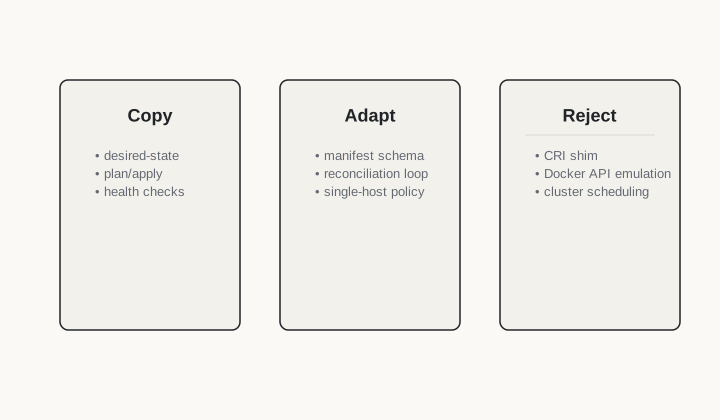
Copy, adapt, reject
Hostwright studies prior art and decides explicitly what to take:
| Source idea | Decision | What Hostwright does |
|---|---|---|
| Kubernetes controllers | Adapt | A local observe–diff–plan–apply–observe loop. |
| Kubernetes API server | Reject (for now) | Single-host control needs no distributed API server. |
| Container Runtime Interface (CRI) | Study, don’t implement | Inspiration for the adapter boundary, not a shim. |
| Docker Compose | Adapt lightly | A readable local stack format, not full parity. |
| Docker API compatibility | Reject as core | Already covered elsewhere; distracts from controller-first design. |
| Apple container CLI | Adopt initially | Structured output behind the adapter while native APIs settle. |
| Containerization APIs | Adopt when stable | A Swift-native runtime path, later. |
Why CRI is deferred
CRI is a strong design reference for a runtime boundary, which is exactly how Hostwright uses it — as inspiration for the RuntimeAdapter. Implementing CRI itself would mean committing to Kubernetes’ contract and node-agent semantics that single-host Hostwright does not need.
Why full Compose parity is deferred
Compose is large. Chasing 100% parity would turn Hostwright into a compatibility project instead of a control plane. Hostwright takes the readable-local-stack idea and stops there, deliberately narrower than Compose.
Why Docker API emulation is avoided
A Docker API shim is a real thing developers want — and other projects already provide it. Re-implementing it as Hostwright’s core would dilute the controller-first design for little gain.
Why a cloud control plane is out
Hostwright is single-host by design. A hosted control plane, multi-Mac orchestration, and remote state are a different product with different failure modes. Adding them would compromise the local model that is the whole point.
Why GPU and accelerator claims are research-only
Apple silicon acceleration — GPU/ANE scheduling, Metal, Core ML, MLX in containers — is genuinely interesting and genuinely hard. It is treated as research, not as a feature. Hostwright will not claim accelerator capabilities it has not built and tested.
Why destructive cleanup must be conservative
A tool that deletes the wrong thing once loses trust permanently. So cleanup is ownership-aware, dry-run by default, and never touches resources Hostwright cannot prove it owns. This is covered in the safety model.
The full list
For the compact list of non-goals as they appear on the homepage — no CRI shim, no Kubernetes replacement, no Docker API shim, no cloud control plane, no tunnel manager, no GPU scheduler, no web dashboard, not production-ready — see the home page and Limitations.